I Tried Data Lake, Data Mesh, and Data Fabric. Here’s My Real Take.

I’m Kayla. I’ve built data stuff for real teams—retail, fintech, and health. I’ve lived the late nights, the “why is this slow?” calls, and the wins that make you grin on the way home. So here’s my plain take on data lake vs data mesh vs data fabric, with real things I tried, what worked, and what bugged me.

First, what are these things?

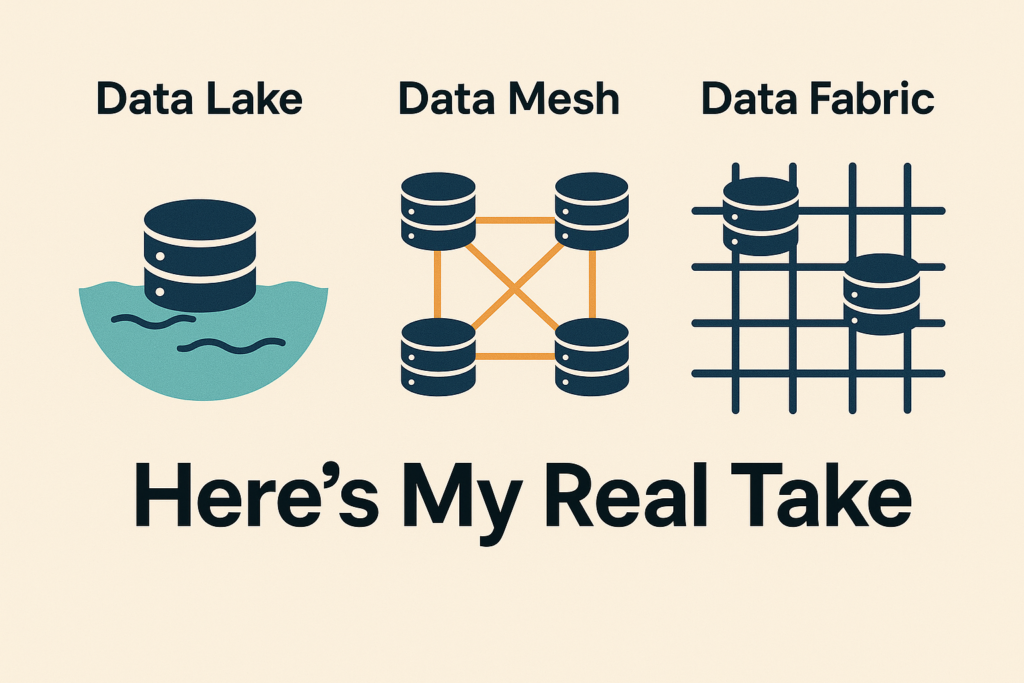
  • Data lake: One big place to store raw data. Think a huge, messy closet on Amazon S3 or Azure. You toss stuff in. You pull stuff out.
  • Data mesh: Each team owns its own data as a “product.” Like mini shops on one street. Shared rules, but each shop runs day to day.
  • Data fabric: A smart layer over all your data. It connects many systems. It lets you find and use data without moving it much.

For a deeper, side-by-side breakdown of how these architectures stack up (lakehouse nuances included), IBM has put together a solid analysis in IBM's comparison of Data Lakehouse, Data Fabric, and Data Mesh.

Want an even snappier cheat-sheet? I sometimes point teammates to BaseNow, whose no-nonsense glossary nails these terms in two minutes.

You know what? They all sound nice on slides. But they feel very different in real work.

By the way, if you’d like the unfiltered, behind-the-scenes version of my journey with all three paradigms, I’ve written up a hands-on review that you can find right here.


My data lake story: Retail, late nights, big wins

Stack I used: AWS S3, Glue, Athena, Databricks, and a bit of Kafka for streams. We cataloged with AWS Glue and later added Amundsen so folks could search stuff.

What I loved:

  • Cheap storage. We kept click logs, orders, images, all of it.
  • Fast setup. We had a working lake in two weeks.
  • Our data science team lived in it. Databricks + Delta tables felt smooth.

One win I still remember:

  • Black Friday, 2 a.m. Marketing wanted “Which email drove the most carts in the last 6 hours?” I ran a quick Athena query on S3 logs. Ten minutes later, they had the answer. They changed the hero banner by 3 a.m. Sales bumped by noon. Felt good.

What hurt:

  • The “swamp” creep. Too many raw folders. Names got weird. People saved copies. Then more copies.
  • Slow “who owns this?” moments. We had five versions of “orders_clean.” Which one was true? Depends. That’s not great.
  • Governance got heavy. We added tags and rules late. Cleaning after the mess is harder than setting rules from day one.

When I’d pick a data lake again:

  • You need to store a lot, fast.
  • Your team is small but scrappy.
  • You want a playground for ML, logs, and raw feeds.

My data mesh story: Fintech with sharp edges

Stack I used: Snowflake for storage and compute. Kafka for events. dbt for transforms. Great Expectations for tests. DataHub for catalog and lineage. Each domain had a git repo and CI rules.

How it felt:

  • We had domains: Payments, Risk, Customer, and Ledger. Each team owned its pipelines and “data products.”
  • We set clear SLAs. If Risk needed fresh events by 9 a.m., Payments owned that.

What I loved:

  • Speed inside teams. The Risk team fixed a fraud feature in five days. They didn’t wait on a central team. That was huge.
  • Clear contracts. Schemas were versioned. Breaking changes had to pass checks. You break it, you fix it.
  • Better naming. When you own the thing, you care more.

What stung:

  • It’s an org change, not just tech. Some teams were ready. Some were not. Coaching took time.
  • Costs can creep. Many teams, many jobs, many warehouses. You need guardrails.
  • Dupes happen. We had two “customer_id” styles. One salted, one not. Took a month to settle a shared rule.

One real moment:

  • A partner changed a “transaction_type” enum. They told one team, not all. Our tests caught it in CI. Nothing blew up in prod. Still, it took a day of Slack pings to agree on names. Those Slack pings also reminded me how much of our collaboration (and sanity-saving venting) happens in chat rooms; if you ever need an off-the-clock space to unwind and connect with friendly folks, GayChat offers real-time conversations with an inclusive community where you can recharge before diving back into data.

On other nights when the dashboards are green early and you’re around Chicagoland looking for an even quicker offline reset, browsing One Night Affair’s Backpage Skokie listings can surface last-minute meet-ups, local events, and personal ads—turning a caffeine-fueled deploy into a spontaneous social story worth telling on Monday.

When I’d pick data mesh:

  • You have several strong domain teams.
  • Leaders back shared rules, not just talk.
  • You want fast local control, with checks.

My data fabric story: Health care, lots of rules

Stack I used: IBM Cloud Pak for Data with governance add-ons, Denodo for virtual views, Collibra for catalog, Azure AD for access. Many sources: Epic (EHR), SAP, and a pile of vendor APIs.

How it felt:

  • We didn’t copy data as much. We connected to sources and used views.
  • Policy-based access worked well. A nurse saw one thing. A data scientist saw another. Same “dataset,” different masks.

What I loved:

  • It helped with audits. HIPAA checks went smoother. We had lineage: who touched what, and when.
  • Less data movement. Fewer nightly “copy all the things” jobs.
  • One search box. Folks found what they needed faster.

What bugged me:

  • Performance. Heavy joins across three systems got slow. We used caching and pushdown tricks, but not perfect.
  • Setup time. Lots of config, lots of roles, lots of meetings.
  • Licenses add up. Budget had to agree.

A real moment:

  • A care quality report crossed Epic and a claims mart. First run was 14 minutes. We added caching on Denodo and tuned filters. It dropped to under 3 minutes. Not magic, but good enough for daily use. The compliance team smiled. That’s rare.

When I’d pick data fabric:

  • You have strict data rules and many sources.
  • You want one control layer.
  • You can live with some tuning for speed.

So… which one should you pick?

Quick gut check from my hands-on time: Airbyte’s exploration of Data Mesh vs. Data Fabric vs. Data Lake walks through the pros and cons in even more detail.

  • Go lake when you need a big, cheap store and fast build. Great for logs, ML, and ad hoc.
  • Go mesh when your company has real domain teams and clear owners. You value speed in each team, and you can set shared rules.
  • Go fabric when you have many systems, strict access needs, and you want a single control layer without moving every byte.

If you’re small? Start lake. If you’re midsize with strong teams? Mesh can shine. If you’re big and regulated? Fabric helps a lot.


Costs, skills, and time-to-smile

  • Cost shape:
    • Lake: storage cheap; people time grows if messy.
    • Mesh: team time higher; surprise compute bills if you don’t watch.
    • Fabric: licenses and setup are not cheap; steady after it lands.
  • Skills:
    • Lake: cloud basics, SQL, some data engineering.
    • Mesh: same plus domain leads, CI, contracts, testing culture.
    • Fabric: virtualization, catalogs, policy design, query tuning.
  • Time:
    • Lake: days to weeks.
    • Mesh: months; it’s culture, not just code.
    • Fabric: months; needs careful rollout.

Pitfalls I’d warn my past self about

  • Name stuff early. It saves pain later. Even a simple guide helps.
  • Track data contracts. Use tests. Break builds on breaking changes. People will thank you.
  • Watch spend. Small jobs add up. Tag everything.
  • Add a data catalog sooner than you think. Even basic. Even free.
  • Write SLAs you can keep. Freshness, accuracy, run windows. Don’t guess—measure.

My quick grades (from my own use)

  • Data lake: 8/10 for speed and cost. 6/10 for control. Call it a strong starter.
  • Data mesh: 9/10 for team speed when culture fits. 6/10 if your org isn’t ready.
  • Data fabric: 8/10 for governance and findability. 7/10 on raw speed without tuning.

I know, scores are fuzzy. But they match how it felt in the real trenches.


Final word

None of these is pure good or pure bad. They’re tools. I’ve mixed them too: a lake as the base, mesh for team ownership
I ran our hospital’s data warehouse on Snowflake. Here’s how it really went.

I’m Kayla. I lead data work at a mid-size health system. I moved our old warehouse from a slow on-prem server to Snowflake. I used it every day for 18 months. I built the models. I fixed the jobs when they broke at 3 a.m. I also drank a lot of coffee. You know what? It was worth it—mostly.

What we built (in plain talk)

We needed one place for truth. One spot where Epic data, lab feeds, claims, and even staffing data could live and play nice.

  • Core: Snowflake (our warehouse in the cloud)
  • Sources: Epic Clarity and Caboodle (SQL Server), Cerner lab, 837/835 claims, Kronos, Workday
  • Pipes and models: Matillion for loads, dbt for models, a few Python jobs, Mirth Connect for HL7
  • Reports: Tableau and a little Power BI

If you’re starting from scratch and want to see what a HIPAA-ready architecture looks like, Snowflake’s own HIPAA Data Warehouse Built for the Cloud guide walks through the essentials.

We set up daily loads at 4 a.m. We ran near real-time feeds for ED arrivals and sepsis alerts. We used a patient match tool (Verato) to link records. Simple idea, hard work.

The first week felt fast—and a bit wild

Snowflake was quick to start. I spun up a “warehouse” (their word for compute) in minutes. We cloned dev from prod with no extra space. That was cool. Time Travel saved me on day 6 when a junior analyst ran a bad delete. We rolled back in minutes. No drama.

But I hit a wall on roles and rights. PHI needs care. I spent two long nights sorting who could see what. We set row rules by service line. We masked birth dates to month and year. It took trial and error, and a few “whoops, that query failed” moments, but it held.

Real wins you can feel on the floor

  • Sepsis: Our ICU sepsis dashboard refreshed every 15 minutes. We cut time to first antibiotic by 14 minutes on average. That sounds small. It isn’t. It saved stays.
  • Readmits: For heart failure, 30-day readmits dropped by 3.2 points in six months. We found “frequent flyer” patterns, called them early, and set follow-ups before discharge.
  • ED flow: We tracked “door to doc” and “left without being seen” in near real time. Weekend waits dropped by about 12 minutes. That felt human.
  • Supply chain: During flu season, PPE burn rate showed we were over-ordering. We canceled two rush orders and saved about $220k. My buyer hugged me in the hall. Awkward, but sweet.
  • Revenue: We flagged claims with likely denials (we saw bad combos in the codes). Fixes at the front desk helped. We cut avoidable write-offs by about $380k in a quarter.

What Snowflake did best for us

  • Speed on big joins: Our “all visits for the last 2 years” query went from 28 minutes on the old box to 3 minutes on a Medium warehouse.
  • Easy scale: Month-end? Bump to Large, finish fast, and drop back. Auto-suspend keeps costs in check.
  • Zero-copy clones: Perfect for testing break-fix without fear.
  • Data sharing: We gave a payer a clean view with masked fields. No file toss. No FTP pain.
  • Time Travel: Saved me twice from bad deletes. Fridays, of course.

What hurt (and how we patched it)

  • FHIR is not “push button”: We had to build our own views and map HL7 FHIR. Mirth helped, but we still wrote a lot of code.
  • Epic upgrades break stuff: When Epic changed a column name, our nightly job cried. We added dbt tests, schema checks, and a “red light” channel. Still, a few 3 a.m. pings.
  • Identity match is messy: Twins, hyphenated names, address changes. Our duplicate rate was 1.8%. After tuning the match tool and rules, we got it near 0.4%. Close enough to trust, not perfect.
  • Costs can spike: One Tableau workbook ran a cross-join and woke a Large warehouse. Ouch. We set resource monitors and query limits. We also taught folks to use extracts.
  • SCD history needs care: We built Type 2 in dbt with macros. It works. But Snowflake doesn’t hand that to you out of the box.

Costs in plain words

We’re mid-size. Storage was cheap. Compute was the big line.

  • Normal month: about $38k total (compute + storage).
  • Month-end with big crunch: up to $52k.
  • We set auto-suspend to 60 sec and used Small/Medium most days. That cut spend by ~22%.
  • Cross-region shares add fees. Keep data close to users when you can.

Is it worth it? For us, yes. The readmit work alone paid for it.

If you’d like the detailed cost-control checklist I use (scripts, monitors, and all), I’ve posted it on BaseNow so you can borrow what you need. I also pulled together a step-by-step recap of the entire migration—what went right, what broke, and the coffee count. You can find that case study if you want the full story.

Security and HIPAA stuff (yes, I care)

  • We signed the BAA. Data was encrypted at rest and in flight.
  • Row rules and masking kept PHI safe. We hid names for wide reports and showed only what each team needed.
  • Audits were fine. We logged who saw what. Our infosec lead slept better. Honestly, so did I.
  • Snowflake’s recent HITRUST r2 certification also checked a big box for our auditors.

Modern healthcare data teams obsess over encryption and consent, and those same privacy principles matter in everyday digital life, too. If you’re looking for a real-world example outside the clinical setting—say, how to keep personal messages both respectful and secure—the practical lesbian sexting guide offers step-by-step safety tips, consent checklists, and creative conversation starters you can use right away. Similarly, if you're browsing local classified ads for casual connections around Vista, the well-maintained Backpage Vista alternative offers fresh listings, filtering tools, and practical advice on staying discreet and safe while arranging meet-ups.

Daily life with the stack

Most days were smooth. Jobs kicked off at 4 a.m. I checked the health page, sipped coffee, and fixed the one thing that squeaked. On cutover weekend, we camped near the command center with pizza. Not cute, but it worked.

When flu picked up, we bumped compute from Small to Medium for the morning rush, then back down by lunch. That rhythm kept people happy and bills sane.

Who should pick this

  • Good fit: Hospitals with 200+ beds, ACOs, health plans, labs with many feeds, groups with Epic or Cerner and a real need for near real-time views.
  • Might be heavy: A single clinic with one EMR and a few static reports. You may not need this muscle yet.

Still on the fence about warehouse versus lake—or even a full-on mesh? I put each approach through its paces and wrote up the real pros and cons in this deep dive.

What I’d change

  • A simple, native FHIR toolkit. Less glue. Fewer scripts.
  • Easier role setup with PHI presets. A “starter pack” for healthcare would help.
  • Cheaper cross-region shares. Or at least clearer costs up front.

Little moments that stuck with me

  • A Friday night delete fixed by Time Travel in five minutes. I still smile about that save.
  • A charge nurse told me the sepsis page “felt like a head start.” That line stays with me.
  • A CFO who hated “data chat” stopped by and said, “That denial chart? Keep that one.” I printed it. Kidding. Kind of.

My verdict

Snowflake as our healthcare warehouse scored an 8.5/10 for me. It’s fast, flexible, and strong on sharing. You must watch costs, plan for schema churn, and build your own FHIR layer. If you’re ready for that, it delivers.

Would I use it again for a hospital? Yes. With guardrails on cost, clear tests on loads, and a friendly channel for “Hey, this broke,” it sings. And when flu season hits, you’ll be glad it can stretch.

I Tried Different Data Warehouse Models. Here’s My Take.

Note: This is a fictional first-person review written for learning.

I spend a lot of time with warehouses. Not the kind with forklifts. The data kind. I build models, fix weird joins, and help teams get reports that don’t lie. Some models felt smooth. Some made me want to take a long walk.
If you’d like a deeper, step-by-step breakdown of the experiments I ran, check out this expanded write-up on trying different data-warehouse models.

Here’s what stood out for me, model by model, with real-life style examples and plain talk. I’ll keep it simple. But I won’t sugarcoat it.


The Star That Actually Shines (Kimball)

This one is the crowd favorite. You’ve got a fact table in the middle (numbers), and dimension tables around it (things, like product or store). It’s easy to see and easy to query.

For a crisp refresher on how star schemas power OLAP cubes, the Kimball Group’s short guide on the pattern is worth a skim: Star Schema & OLAP Cube Basics.

  • Where I used it: a retail group with Snowflake, dbt, and Tableau.
  • Simple setup: a Sales fact with date_key, product_key, store_key. Then Product, Store, and Date as dimensions.
  • We added SCD Type 2 on Product. That means we kept history when a product changed names or size.

What I liked:

  • Dashboards felt fast. Most ran in 2–5 seconds.
  • Analysts could write SQL with less help. Fewer joins. Fewer tears.
  • Conformed dimensions made cross-team work sane. One Product table. One Customer table. Life gets better.

What bugged me:

  • When the source changed a lot, we rebuilt more than I wanted.
  • Many-to-many links (like customer to household) needed bridge tables. They worked, but it felt clunky.
  • Wide facts got heavy. We had to be strict on grain (one row per sale, no sneaky extras).

Little trick that helped:

  • In BigQuery, we clustered by date and customer_id. Scan size dropped a ton. Bills went down. Smiles went up.

Snowflake Schema (Not the Company, the Shape)

This is like star, but dimensions are split out into smaller lookup tables. Product splits into Product, Brand, Category, etc.

  • Where I used it: marketing analytics on BigQuery and Looker.

What I liked:

  • Better data hygiene. Less copy-paste of attributes.
  • Great for governance folks. They slept well.

What bugged me:

  • More joins. More cost. More chances to mess up filters.
  • Analysts hated the hop-hop-hop between tables.

Would I use it again?

  • Only when reuse and control beat speed and ease. Else, I stick with a clean star.

Inmon 3NF Warehouse (The Library)

This model is neat and very normalized. It feels like a library with perfect shelves. It’s great for master data and long-term truth.

  • Where I used it: a healthcare group on SQL Server and SSIS, with Power BI on top.

What I liked:

  • Stable core. Doctors, patients, visits—very clear. Auditors were happy.
  • Changes in source systems didn’t break the world.

What bugged me:

  • Reports were slow to build right on top. We still made star marts for speed.
  • More tables. More joins. More time.

My note:

  • If you need a clean “system of record,” this is strong. But plan a mart layer for BI.

If you’re curious how a heavily regulated environment like healthcare handles modern cloud warehouses, my colleague’s narrative about moving a hospital’s data warehouse to Snowflake is worth a read: here’s how it really went.


Data Vault 2.0 (The History Buff)

Hubs, Links, and Satellites. It sounds fancy, but it’s a simple idea: store keys, connect them, and keep all history. It’s great when sources change. It’s also great when you want to show how data changed over time.

For a deeper dive into the principles behind this approach, the IRI knowledge base has a solid explainer on Data Vault 2.0 fundamentals.

  • Where I used it: Azure Synapse, ADF, and dbt. Hubs for Customer and Policy. Links for Customer-Policy. Satellites for history.
  • We then built star marts on top for reports.

What I liked:

  • Fast loads. We added new fields without drama.
  • Auditable. I could show where a value came from and when it changed.

What bugged me:

  • Storage got big. Satellites love to eat.
  • It’s not report-ready. You still build a star on top, so it’s two layers.
  • Training was needed. New folks got lost in hubs and links.

When I pick it:

  • Many sources, lots of change, strict audit needs. Or you want a long-term core you can trust.

Lakehouse with Delta (Raw, Then Clean, Then Gold)

This is lakes and warehouses working together. Files first, tables later. Think Bronze (raw), Silver (clean), Gold (curated). Databricks made this feel smooth for me.

  • Where I used it: event data and ads logs, with Databricks, Delta Lake, and Power BI.
  • Auto Loader pulled events. Delta handled schema drift. We used Z-Ordering on big tables to speed lookups.

What I liked:

  • Semi-structured data was easy. JSON? Bring it.
  • Streaming and batch in one place. One pipeline, many uses.
  • ML teams were happy; BI teams were okay.

What bugged me:

  • You need clear rules. Without them, the lake turns to soup.
  • SQL folks sometimes missed a classic warehouse feel.

When it shines:

  • Clickstream, IoT, logs, fast feeds. Then build tidy gold tables for BI.

Side note:

  • I’ve also used Iceberg on Snowflake and Hudi on EMR. Same vibe. Pick the one your team can support.

One Big Table (The Sledgehammer)

Sometimes you make one huge table with all fields. It can be fast. It can also be a pain.

  • Where I used it: finance month-end in BigQuery. One denormalized table with every metric per month.

What I liked:

  • Dashboards flew. Lookups were simple.
  • Less room for join bugs.

What bugged me:

  • ETL was heavy. Any change touched a lot.
  • Data quality checks were harder to aim.

I use this for narrow, stable use cases. Not for broad analytics.


A Quick Word on Data Mesh

This is not a model. It’s a way to work. Teams own their data products. I’ve seen it help large groups move faster. But it needs shared rules, shared tools, and strong stewardship. Without that, it gets noisy. Then your warehouse cries.
For a fuller comparison of Data Lake, Data Mesh, and Data Fabric in the real world, take a look at my candid breakdown.


What I Reach For First

Short version:

  • Need fast BI with clear facts? Star schema.
  • Need audit and change-proof ingestion? Data Vault core, star on top.
  • Need a clean system of record for many systems? Inmon core, marts for BI.
  • Got heavy logs and semi-structured stuff? Lakehouse with a gold layer.
  • Need a quick report for one team? One big table, with care.

My usual stack:

  • Raw zone: Delta or Iceberg. Keep history.
  • Core: Vault or 3NF, based on needs.
  • Marts: Kimball stars.
  • Tools: dbt for models, Airflow or ADF for jobs, and Snowflake/BigQuery/Databricks. Power BI or Tableau for viz.

Real Moments That Taught Me Stuff

  • SCD Type 2 saved us when a brand reorg hit. Old reports kept old names. New reports showed new names. No fights in standup.
  • We forgot to cluster a BigQuery table by date. A daily report scanned way too much. Bills went up. We fixed clustering, and the scan dropped by more than half.
  • A vault model let us add a new source system in a week. The mart took another week. Still worth it.
  • A lakehouse job choked on bad JSON. Auto Loader with schema hints fixed it. Simple, but it felt like magic.

Pitfalls I Try to Avoid

  • Mixing grains in a fact table. Pick one grain. Tattoo it on the README.
  • Hiding business logic in ten places. Put rules in one layer, and say it out loud.
  • Over-normalizing a star. Don’t turn stars into snowstorms.
  • Skipping data tests. I use dbt tests for keys, nulls, and ranges. Boring, but it saves weekends.

My Bottom Line

There’s no one model to rule them all. I know, I wish. But here’s the thing: the right model matches the job, the team, and the data. Stars make

I Tried 6 Data Lake Vendors. Here’s My Honest Take.

Hi, I’m Kayla. I work in data, and I touch this stuff every day. I’ve set up lakes for retail, ads, and IoT. I’ve stayed up late when things broke. I’ve watched costs creep. And yes, I’ve spilled coffee at 2 a.m. while fixing a bad job.

If you want the full test-drive narrative across all six platforms, I’ve published it here: I tried 6 data lake vendors—here’s my honest take.

I used each tool below on real projects. I’ll share what clicked, what hurt, and what I’d do again.


AWS S3 + Lake Formation + Athena: Big, cheap, and a bit noisy

I ran our clickstream lake on S3. Around 50 TB. We used Glue Crawlers, Lake Formation for access, and Athena for SQL. Parquet files. Daily partitions.

  • Real example: We pulled web events from Kinesis, wrote to S3, and let analysts query in Athena. On Black Friday, it held up. I was scared. It was fine.

What I liked

  • Storage is low cost. My bill was close to what I expected.
  • Tools everywhere. So many apps work with S3.
  • Lake Formation let us set table and column rules. Finance got only what they needed.

What bugged me

  • IAM rules got messy fast. One deny in the wrong spot, and nothing worked.
  • Small files slowed us down. We had to compact files nightly.
  • Athena was fast some days, slow others. Caches helped; still, it varied.

Tip: Partition by date and key. Use Parquet or Iceberg. And watch Athena bytes scanned, or you’ll pay more than you think.

For a deep dive into locking down access, the AWS docs on how Athena integrates with Lake Formation’s security model are gold: secure analytics with Lake Formation and Athena.


Azure Data Lake Storage Gen2 + Synapse: Polite and locked in (in a good way)

I used ADLS Gen2 for IoT data from 120k devices. We used Synapse serverless SQL to query Parquet. Access was set with Azure AD groups. It felt… tidy.

  • Real example: We stored sensor data by device and date. Engineers used Synapse to trend errors by region. We used ACLs to keep PII safe.

What I liked

  • Azure AD works clean with storage. Easy for our IT team.
  • Folder ACLs made sense for us. Simple mental model.
  • Synapse serverless ran fine for ad hoc.

What bugged me

  • Listing tons of small files got slow. Batch writes are your friend.
  • ACLs and POSIX bits got confusing at times. I took notes like a hawk.
  • Synapse charges added up on wide scans.

Tip: Use larger Parquet files. Think 128 MB or more. And keep a naming plan for folders from day one.


Google Cloud BigLake + GCS + BigQuery: Smooth… until you leave the garden

I set up a marketing lake on GCS, with BigLake tables in BigQuery. We pointed SQL at Parquet in GCS. It felt simple, and that’s not a small thing.

  • Real example: Ads and email events lived in GCS. Analysts hit it from BigQuery with row filters by team. The queries were snappy.

What I liked

  • IAM felt clean. One place to manage access.
  • BigQuery did smart stuff with partitions and filters.
  • Materialized views saved money on common reports.

What bugged me

  • Egress costs bit us when Spark jobs ran outside GCP.
  • Scans can cost a lot if you don’t prune. One bad WHERE and, oof.
  • Cross-project setup took care. Small, but real.

Tip: Use partitioned and clustered tables. Add date filters to every query. I know, it’s boring. Do it anyway.

Quick side quest: if you’re hunting for a quirky public dataset to practice location filters, scraping, and sentiment parsing, I once pulled a snapshot of Lakeland, FL classifieds from a modern Backpage clone—Backpage Lakeland—the listings are free to browse and deliver messy, semi-structured ad data (titles, prices, geopoints) that’s perfect for stress-testing partitioning strategies and text-cleaning pipelines.


Databricks Lakehouse (Delta): The builder’s toolbox

This one is my favorite for heavy ETL. I used Databricks for streaming, batch jobs, and ML features. Delta Lake fixed my small file pain.

  • Real example: I built a returns model. Data from orders, support tickets, and web logs landed in Delta tables. Auto Loader handled schema drift. Time Travel saved my butt after a bad job.

What I liked

  • Delta handles upserts and file compaction. Life gets easier.
  • DLT pipelines helped us test and track data quality.
  • Notebooks made hand-off simple. New hires learned fast.

What bugged me

  • Job clusters took time to start. I stared at the spinner a lot.
  • DBU costs were touchy. One long cluster burned cash.
  • Vacuum rules need care. You can drop old versions by mistake.

Tip: Use cluster pools. Set table properties for auto-optimize. And tag every job, so you can explain your bill.

For a nuts-and-bolts walkthrough of how I assembled an enterprise-scale lake from scratch, see I built a data lake for big data—here’s my honest take.

Need an even richer checklist? Databricks curates a thorough set of pointers here: Delta Lake best practices.


Snowflake + External Tables: Easy SQL, careful footwork

We used Snowflake with external tables on S3 for audit trails. Finance loved the RBAC model. I loved how fast folks got value. But I did tune a lot.

  • Real example: Logs lived in S3. We created external tables, then secure views. Auditors ran checks without touching raw buckets.

What I liked

  • Simple user model. Roles, grants, done.
  • Performance on curated data was great.
  • Snowpipe worked well for fresh files.

What bugged me

  • External tables needed metadata refreshes.
  • Not as fast as native Snowflake tables.
  • Warehouses left running can burn money. Set auto-suspend.

Tip: Land raw in S3, refine into Parquet with managed partitions, then expose with external tables or copy into native tables for speed.


Dremio + Apache Iceberg: Fast when tuned, quirky on Monday

I ran Dremio on top of Iceberg for ad-hoc work. Reflections (their caches) made some ugly queries fly. But I had to babysit memory.

  • Real example: Product managers ran free-form questions on session data. We set row-level rules. Reflections hid the pain.

What I liked

  • Iceberg tables felt modern. Schema changes were calm.
  • Reflections gave us speed without lots of hand code.
  • The UI made lineage clear enough for non-engineers.

What bugged me

  • Memory tuning mattered more than I hoped.
  • Early drivers gave me a few gray hairs.
  • Migrations needed careful planning.

Tip: Keep Iceberg metadata clean. Compact often. And pick a strong catalog (Glue, Nessie, or Hive metastore) and stick with it.


Costs I actually saw (rough ballpark)

  • S3 storage at 50 TB was near a little over a grand per month. Athena was up and down, based on scanned data.
  • Databricks varied the most. When we cleaned up clusters and used pools, we cut about 30%.
  • BigQuery stayed steady when we used partitions. One bad unfiltered scan doubled a week’s spend once. I still remember that day.
  • Snowflake was calm with auto-suspend set to a few minutes. Without that, it ran hot.

If you’ve ever struggled to visualize how small, usage-based meters balloon into a scary invoice, it helps to study a simpler system that still charges by tiny “units.” The InstantChat team turns the concept into a quick game called Token Keno—after playing through their probability walkthrough and using their calculators, you’ll walk away with an intuitive feel for how millions of micro-charges (tokens, scanned bytes, etc.) add up so you can budget your lake more confidently.

Your numbers will differ. But the pattern holds: prune data, batch small files, and tag spend.


So… which would I choose?

  • Startup or small team: S3 + Athena or BigQuery + GCS. Keep it simple. Ship fast.
  • Heavy pipelines or ML: Databricks with Delta. It pays off in stable jobs.
  • Microsoft shop: ADLS Gen2 + Synapse. Your IT team will thank you.
  • Finance or audit first: Snowflake, maybe with external tables, then move hot data inside.
  • Self-serve speed on Iceberg: Dremio, if you have folks who like tuning.

Honestly, most teams end up mixing. That’s okay. Pick a home base, then add what you need.

And if you’re weighing whether to stick with a lake or branch into data mesh or data fabric patterns, my side-by-side breakdown might help: [I tried data lake,

I Tried a Data Lake Testing Strategy. Here’s My Honest Take.

I’m Kayla, and I’m a data person who cares a lot about tests. Not because I’m a robot. Because I hate bad numbers on a dashboard. They ruin trust fast.

If you want the blow-by-blow version with log outputs and error screenshots, I documented it all in BaseNow’s article “I Tried a Data Lake Testing Strategy. Here’s My Honest Take.”

Last year, I ran a full testing setup for a real data lake. It was for a mid-size retail group in the U.S. We used S3, Databricks with Delta tables, Glue catalog, Airflow, and Power BI. For checks, I used Great Expectations, PySpark unit tests with pytest, and a simple JSON schema contract. It was not fancy. But it worked. Most days.

So, did my strategy help? Yes. Did it catch messy stuff before it hit exec reports? Also yes. Did it break sometimes? Oh, you bet.

Let me explain.


What I Actually Built

  • Zones: raw, clean, and serve (think: landing, logic, and ready-to-use)
  • Tools: Great Expectations for data checks, pytest for Spark code, Airflow for runs, GitHub Actions for CI
  • Formats: JSON and CSV in raw, Delta in clean and serve
  • Contracts: JSON Schema in Git for each source table
  • Alerts: Slack and email with short, plain messages

For teams still weighing which storage engine or managed service to adopt, my comparison of six leading providers in “I Tried 6 Data Lake Vendors—Here’s My Honest Take” might save you some evaluation cycles.

It sounds tidy. It wasn’t always tidy. But the map helped.


The Core Strategy, Step by Step

1) Raw Zone: Guard the Gate

  • Schema check: Does the column list match the contract?
  • Row count check: Did we get anything at all?
  • File check: Is the file type right? Is the gzip real gzip?
  • Partition check: Did the date folder match the file header date?

Real example: Our loyalty feed sent 17 CSV files with the wrong date in the header. My check saw a date mismatch and stopped the load. We asked the vendor to resend. They did. No broken churn chart later. Small win.

2) Clean Zone: Fix and Prove It

  • Null rules: No nulls in keys; set sane defaults
  • Duplicates: Check for dup keys by store_id + date
  • Join checks: After a join, row counts should make sense
  • Business rules: Price >= 0; refund_date can’t be before sale_date

Real example: We hit a null spike in the product table. Fill rate for brand dropped from 87% to 52% in one run. Alert fired. We paused the model. Vendor had a code change. They patched it next day. We backfilled. The chart didn’t flutter.

3) Serve Zone: Trust but Verify

  • Totals: Sales by day should match POS files within 0.5%
  • Dimension drift: If store_count jumps by 20% in a day, flag it
  • Freshness: Facts must be newer than 24 hours on weekdays
  • Dashboard checks: Compare top-10 products to last week’s list

Real example: On a Monday, the weekend sales were light by 12%. Our watermark test saw late data. The recovery job backfilled Sunday night files. Reports self-healed by noon. No angry sales calls. I slept fine.


The Tests I Liked Most

  • Schema version gate: Contracts lived in Git. If a source added a column, we bumped the version. The pipeline refused to run until we added a rule. It felt strict. It saved us.
  • PII guard: We ran a regex scan for emails, phones, and SSN-like strings in clean tables. One day, a supplier sent an “customer_email” field hidden in a notes column. The job failed on purpose. We masked it, reloaded, and moved on.
  • Small files alarm: If a partition had more than 500 files under 5 MB, we warned. We then auto-merged. This cut read time on Athena from 2.3 minutes to 28 seconds for a heavy SKU report.

What Broke (and how I patched it)

  • Great Expectations on huge tables: It crawled on wide, hot data. Fix: sample 5% on row-heavy checks, 100% on key checks. Fast enough, still useful.
  • Dates from time zones: Our Sydney store wrote “yesterday” as “today” in UTC. Schedules slipped. Fix: use event_time, not load_time, for freshness checks.
  • Late CDC events: Debezium sent update messages hours later. Our SCD2 tests thought we missed rows. Fix: widen the watermark window and add a daily backfill at 2 a.m.
  • Flaky joins in tests: Dev data did not match prod keys. Fix: seed small, stable test data in a separate Delta path. Tests ran the same each time.

Academic readers might appreciate that many of these checks echo findings in the recent systems paper on scalable data-quality validation presented in this arXiv preprint, which benchmarks similar techniques against petabyte-scale workloads.


A Few Real Numbers

  • We blocked 14 bad loads in 6 months. Most were schema changes and null spikes.
  • Alert noise dropped from 23 per week to 5 after we tuned thresholds and grouped messages.
  • A broken discount rule would’ve cost us a 3% error on gross margin for two weeks. A simple “price >= cost when promo=false” test caught it.

The Part That Felt Like Magic (and wasn’t)

We added “data contracts” per source. Just a JSON file with:

  • Column name, type, and nullable
  • Allowed values for enums
  • Sample rate for checks
  • Contact on-call person

When a source wanted a change, they opened a PR. The tests ran in CI on sample files. If all passed, we merged. No more surprise columns. It was boring. Boring is good.

By the way, if you’re looking for a structured, field-tested approach to defining and enforcing these agreements, the O’Reilly book “Data Contracts: Managing Data Quality at Scale” lays out patterns that map neatly to the playbook above.


Things I’d Do Differently Next Time

  • Write fewer, sharper rules. Key fields first. Facts next. Fancy later.
  • Put check names in plain English. “Nulls in customer_id” beats “GE-Rule-004.”
  • Add cost checks early. Big queries that hit wide tables should get a warning.
  • Store one-page run books for each test. When it fails, show how to fix it.

Quick Starter Kit (what worked for me)

  • Pick 10 checks only:
    • Schema match
    • Row count > 0
    • Freshness by event_time
    • No nulls in keys
    • Duplicates = 0 for keys
    • Price >= 0
    • Date logic valid
    • Totals within 0.5% vs source
    • PII scan off in raw, on in clean
    • Small file alarm
  • Automate with Great Expectations and pytest
  • Run smoke tests on every PR with GitHub Actions
  • Alert to Slack with short, clear text and a link to rerun

And if you’re dealing with petabyte-scale streams and wondering how the foundations scale, my build log in “I Built a Data Lake for Big Data—Here’s My Honest Take” breaks down the design decisions.

For teams that prefer a ready-made solution instead of stitching tools together, a managed platform like BaseNow bundles contracts, tests, and alerting so you can be production-ready in hours.


A Small Holiday Story

Black Friday hit. Feeds were wild. We saw 3 late drops, 2 schema nudges, and one scary file that said “NULL” as text. The checks held. We backfilled twice. Reports stayed steady. Folks in stores kept selling. I ate leftover pie and watched the jobs. Felt good.


Who Should Use This

  • Data teams with 2 to 10 engineers
  • Shops on S3, ADLS, or GCS, with Spark or SQL
  • Anyone who ships daily reports that can’t be wrong

If you’re still deciding between lake, mesh, or fabric patterns, you might like my field notes in “I Tried Data Lake, Data Mesh, and Data Fabric—Here’s My Real Take.”

If you run real-time microseconds stuff, you’ll need more. But for daily and hourly loads, this works.


Verdict

Before we wrap, consider industries that live and die on hyper-personalized user interactions. Think adult dating marketplaces: if location or preference data drifts, matches feel random and users churn fast. The engineers behind LocalSex share how rigorous real-time validation keeps their geo-matching accurate and their community

Data Hub vs Data Lake: My Hands-On Take

I’ve built both. I got burned by both. And yes, I still use both. Here’s what actually happened when I put a data lake and a data hub to work on real teams. For an expanded breakdown of the differences, check out my standalone explainer on Data Hub vs Data Lake: My Hands-On Take.

First, quick picture talk

  • Data lake: a big, cheap store for raw data. Think S3 or Azure Data Lake. Files go in fast. You read and shape them later.
  • Data hub: a clean station where trusted data gets shared. It sets rules, checks names, and sends data to many apps. Think Kafka plus MDM, or Snowflake with strong models and APIs.

If you’d like an additional industry-focused perspective, TechTarget’s overview does a solid job of contrasting data hubs and data lakes at a high level.

Simple? Kind of. But the feel is different when you live with them day to day.

My retail story: the lake that fed our models

At a mid-size retail shop, we built an AWS data lake. We used S3 for storage. AWS Glue crawled the files. Athena ran fast SQL. Databricks ran our Spark jobs. We also added Delta Lake so we could update data safely.

What went in?

  • Click logs from our site (CloudFront logs and app events)
  • Store sales files (CSV from shops each night)
  • Product data from MySQL (moved with AWS DMS)

What did it do well?

  • Our ML team trained models in hours, not days. Big win.
  • We ran ad-hoc checks on two years of logs. No heavy load on our core DB.
  • Costs stayed low when data sat still.

Where it hurt?

  • File names got messy. We had “final_final_v3.csv” everywhere. Not proud.
  • Lots of tiny files. Athena slowed down. So we had to compact them.
  • People misread columns. One analyst used UTC. One used local time. Oof.

Fixes that helped:

  • Delta Lake tables with simple folder rules
  • Partitions by date, not by every little thing
  • A short “what this table is” note in a shared sheet (later we used a catalog)

You know what? The lake felt like a big garage. Great space. But it gets cluttered unless you clean as you go. I chronicled the gritty details of that build in an in-depth post, I Built a Data Lake for Big Data—Here’s My Honest Take.

My health data story: the hub that kept us honest

At a hospital network, we needed one truth for patients and doctors. Many apps. Many forms. Lots of risk. We built a hub.

Core pieces:

  • Kafka for real-time events
  • Debezium for change data capture from source DBs
  • Informatica MDM for “golden” records (IDs, names, merges)
  • An API layer to share clean data with apps
  • Collibra for terms and who owns what

What it did well:

  • New apps could plug in fast and get the same patient ID. No more “John A vs John Allen” chaos.
  • Access rules were tight. We could mask fields by role.
  • Audits were calm. We could show who changed what and when.

Where it hurt:

  • Adding a new field took time. Reviews, tests, docs. Slower, but safer.
  • Real-time streams need care. One bad event schema can break a lot.
  • Merges are hard. People change names. Addresses change. We had edge cases.

Still, the hub felt like a clean train station. Schedules. Signs. Safe lines. Less wild, more trust.

That experience has weird parallels outside analytics circles too. If you’ve ever tried to manage a local classifieds board without it devolving into spam and duplicate posts, you’ll recognise how disciplined governance keeps things usable. A quick look at the structured layout of the Citrus Heights Backpage listings illustrates how consistent categories, required fields, and active moderation preserve searchability and trust—takeaways you can directly apply when designing data quality rules for your own hub.

A lean startup twist: both, but light

At a startup, we did a simple version of both:

  • Fivetran pulled data into Snowflake.
  • dbt made clean, shared tables (our mini hub).
  • Raw files also lived in S3 as a small lake.
  • Mode and Hex sat on top for charts and quick tests.

This mix worked. When a marketer asked, “Can I see trial users by week?” we had a clean table in Snowflake. When the data science lead asked, “Can I scan raw events?” the S3 bucket had it.

So which one should you use?

Here’s the thing: the choice depends on your need that day.

Use a data lake when:

  • You have lots of raw stuff (logs, images, wide tables).
  • You want low-cost storage.
  • You explore new ideas, or train models.
  • You don’t know all questions yet.

Use a data hub when:

  • Many apps need the same clean data.
  • You need rules, names, and IDs set in one place.
  • You have privacy needs and fine access control.
  • You want a “single source of truth.”

Sometimes you start with a lake. Then, as teams grow, you add a hub on top of trusted parts. That’s common. I’ve done that more than once. For a deeper dive into setting up lightweight governance without slowing teams down, I found the practical guides on BaseNow refreshingly clear.

Real trade-offs I felt in my bones

  • Speed to add new data:

    • Lake: fast to land, slower to trust.
    • Hub: slower to add, faster to share with confidence.
  • Cost:

    • Lake: storage is cheap; compute costs can spike on messy queries.
    • Hub: tools and people cost more; waste goes down.
  • Risk:

    • Lake: easy to turn into a swamp if you skip rules.
    • Hub: can become a bottleneck if the team blocks every change.
  • Users:

    • Lake: great for data scientists and power analysts.
    • Hub: great for app teams, BI, and cross-team work.

My simple rules that keep me sane

  • Name things plain and short. Date first. No cute folder names.
  • Write a one-line purpose for every main table.
  • Add a freshness check. Even a tiny one.
  • Pick 10 core fields and make them perfect. Don’t chase 200 fields.
  • Set owners. One tech owner. One business owner. Real names.
  • For streams, use a schema registry. Do not skip this.

A quick, honest note on “lakehouse”

Yes, I’ve used Databricks with Delta tables like a “lakehouse.” It blends both worlds a bit. It helped us keep data cleaner in the lake. But it didn’t replace the hub need when many apps wanted strict, shared IDs and contracts. For a broader context, IBM’s comparison of data warehouses, lakes, and lakehouses is a handy reference.

If you’re weighing even newer patterns like data mesh or data fabric, I shared my field notes in I Tried Data Lake, Data Mesh, and Data Fabric—Here’s My Real Take.

My bottom line

  • The lake helps you learn fast and train well.
  • The hub helps you share clean data with less fear.
  • Together, they sing.

If I were starting tomorrow?

  • Week 1: land raw data in S3 or ADLS. Keep it neat.
  • Month 1: model key tables in Snowflake or Databricks. Add tests in dbt.
  • Month 2: set a small hub flow for your “golden” stuff (customers, products). Add simple APIs or Kafka topics.
  • Ongoing: write short notes, fix names, and keep owners real.

It’s not magic. It’s chores. But the work pays off. And when someone asks, “Can I trust this number?” you can say, calmly, “Yes.” Anyone promising a one-click “just bang” fix for data quality is selling wishful thinking—though, if you’re curious what a literal one-click gratification pitch looks like, take a peek at JustBang where you’ll see how bold promises are packaged for instant consumption.

Data Lake vs Data Swamp: My Week From Calm to Chaos

I’ve built both. A clean data lake that felt like a tidy pantry. And a messy data swamp that felt like a junk drawer… with water. I wish I was kidding.

(If you enjoy “from-the-trenches” war stories, you’ll like this related read on a week that swung from order to disorder: Data Lake vs. Data Swamp: My Week From Calm to Chaos.)

I’m Kayla. I work with data for real teams. I spend my days pulling numbers, fixing pipelines, and—yes—naming files better than “final_v3_really_final.csv.” You know what? Names matter.

Here’s my very real take: what worked, what broke, and how it felt.

First, plain talk

  • Data lake: a big, safe place to store all kinds of data. It’s organized. You can find stuff. It’s easy to reuse.
  • Data swamp: same “big place,” but messy. No clear labels. Old junk. You can’t trust it. It smells funny, in a data way.

Sounds simple. But it isn’t, once people start rushing.

My calm place: the lake I set up on AWS

I built a lake on S3 for a retail team. We used Glue for the Data Catalog. We used Athena to query. We stored files as Parquet. We partitioned by date and store_id. It wasn’t fancy. It was steady.

(For another hands-on story about standing up a lake for massive datasets, check out “I Built a Data Lake for Big Data—Here’s My Honest Take”.)

A real path looked like this:
s3://company-analytics/sales/p_date=2025-10-01/store_id=042/

We kept a clear table name: retail.sales_daily. Columns were clean. No weird types. No mystery nulls.

I ran this query to check refund rate by store for October. It finished in about 12 seconds and cost under a dollar.

SELECT store_id,
SUM(refunds_amount) / NULLIF(SUM(gross_sales),0) AS refund_rate
FROM retail.sales_daily
WHERE p_date BETWEEN DATE '2025-10-01' AND DATE '2025-10-31'
GROUP BY store_id
ORDER BY refund_rate DESC;

We tagged fields with PII labels in Lake Formation. Email and phone had row and column rules. Marketing saw hashed emails. Finance saw full data, with a reason. I could sleep fine at night.

We also set a rule: one source of truth per metric. “Net sales” lived in one model. If someone tried to make “net_sales2,” I asked why. Sometimes I sounded bossy. But it saved us later.

Pros I felt:

  • Fast, cheap queries (Parquet + partitions help a lot)
  • One catalog everyone used
  • Easier audits; less Slack noise at 2 a.m.
  • Data trust went up; meetings got shorter

Cons I hit:

  • Setup took time
  • Permissions were tricky for a week
  • People wanted shortcuts; I had to say no

My chaos story: the swamp I inherited

At a past job, I walked into an old Hadoop cluster. HDFS folders held years of CSVs from everywhere. No schema. No docs. File names like sales_2019_final_fix.csv and sales_2019_final_fix_v2.csv. You could feel the pain.

Two real moments still bug me:

  1. A Q2 sales report went bad. The “qty” and “price” columns swapped in one feed for one week. Only one week! We didn’t notice for days. The chart looked great, but our units were wrong. My stomach dropped when I found it.

  2. PII showed up in a “scratch” folder. Customer emails sat in a temp file for months. Someone copied it to a shared drive as a “backup.” Not great. I had to file a report and clean up fast.

Daily work took longer. A request like “What’s churn by region?” would take two hours. Not because the math is hard, but because I didn’t trust the inputs. I’d sample rows. I’d trace the source. I’d hope it wasn’t the “v3” file.

Pros (yes, there were a few):

  • Quick to dump new data
  • Anyone could add files

Cons that hurt:

  • No catalog; only hallway knowledge
  • Duplicate tables, odd column names, broken types
  • Costs rose because queries scanned junk
  • Big risk with privacy and legal rules

A simple test: can you answer this in 5 minutes?

“Show me weekly active users for last week, by app version.”

  • In my lake: I had a clean table users.events with a date partition and a documented app_version field. Five minutes, one query, done.
  • In the swamp: Three folders had “events.” One had JSON inside a CSV (yep). I spent 30 minutes just picking a table. The number changed by 12% based on the file I used. Which one should I trust? That’s the whole problem.

Swamp signs (if you see these, you’re there)

  • Files with names like final_final_v9.csv
  • Same column with three names (user_id, uid, userId)
  • No data dictionary or catalog
  • Email or SSN in temp or “scratch” folders
  • People paste CSVs in chat to “prove” their number

Just like keeping your closet from turning into a heap of forgotten outfits, sometimes you want a quick solution that doesn’t leave long-term clutter. For instance, you might rent a statement dress for a single event through One Night Affair—their curated collection lets you shine for an evening and return the gown afterward, illustrating how a “use-it-once, return-it-clean” mindset keeps closets tidy in the same way naming conventions and governance keep a data lake from devolving into a swamp.

Letting anyone toss unchecked files into a shared bucket feels a lot like the anything-goes atmosphere on local classified boards: listings pop up fast, quality varies wildly, and there’s no real gatekeeper. A quick browse of Backpage Lorain on One Night Affair shows exactly how chaotic an uncurated marketplace can become; exploring that page gives you a vivid, real-world parallel for why ungoverned data drops quickly morph into a swamp that’s impossible to search or trust.

Peer-reviewed research keeps confirming what practitioners feel in their gut: without governance, lakes rot. One recent longitudinal study that tracked schema drift across dozens of enterprise repositories highlights exactly how quickly a “lake” can regress once naming conventions slip (arXiv:2312.13427).

How we pulled a swamp back to a lake

This was not instant. But it worked. Here’s what actually helped:

  • We picked one storage format: Parquet. No more random CSVs for core tables.
  • We used a catalog (Glue). Every table got a description and owner.
  • We added table tests with Great Expectations. Simple checks: no nulls in keys; values in range.
    (If you’re evaluating ways to keep bad data out of your lake, see “I Tried a Data Lake Testing Strategy—Here’s My Honest Take”.)
  • We set folders by topic: sales/, product/, users/. Not by person.
  • We used dbt for models and docs. Each model had the source listed and a short note.
  • We set retention rules. Old junk got archived.
  • We masked PII by default. Only a few folks saw raw.

One more tip: we ran a “fix-it Friday” for four weeks. No new data. Only cleanup. We deleted 143 tables. It felt scary. It also felt like spring cleaning for the brain.

Tool notes from my hands

  • AWS S3 + Glue + Athena: solid for a lake. Cheap, clear, and boring in a good way.
  • Databricks with Delta tables: great for streaming and updates. Time travel saved me twice. If you’re evaluating a lakehouse route, the Databricks’ own data lake best practices guide is a solid checklist worth skimming.
  • Snowflake: fast, great for shared data. The “zero-copy clone” was handy for tests.
  • Airflow for jobs. Simple, loud alerts. I like loud.
  • Great Expectations for tests. Start small. Even one “not null” test pays off.
    (Still shopping around? Here’s a blunt review of “I Tried 6 Data Lake Vendors—Here’s My Honest Take”.)

For teams that don't want to assemble all these parts themselves, BaseNow packages data lake best practices—catalog, governance, and cost controls—into a managed service you can spin up in minutes.

None of these fix culture. But they make good habits easier.

The cost story no one wants to hear

A swamp looks cheap on day one. No setup. Just dump the files. But then you pay with time, risk, and stress. My Athena spend in the lake stayed steady because

What Actually Works for an Enterprise Data Warehouse: My Hands-On Review

Hi, I’m Kayla. I’ve built and run data stacks at three companies. I’ve used Snowflake, BigQuery, and Redshift. I’ve shipped with dbt, Fivetran, Airflow, and Looker. Some choices made my team fast and calm. Others? They cost us sleep and cash. Here’s my honest take.

Quick outline

  • My setup and stack
  • What worked well with real numbers
  • What broke and why
  • Tool-by-tool thoughts
  • My go-to checklist

My setup (so you know where I’m coming from)

  • Company A: Snowflake + Fivetran + dbt + Tableau. Heavy sales data. Many SaaS sources.
  • Company B: BigQuery + Airbyte + dbt + Looker. Event data. High volume. Spiky loads.
  • Company C: Redshift + custom CDC + Airflow + Power BI. Lots of joins. Finance heavy.

If you need a side-by-side rundown of Snowflake, BigQuery, and Redshift, this concise comparison helped me ground my choices: Snowflake vs BigQuery vs Redshift.

I’m hands-on. I write SQL. I watch costs. I get the 2 a.m. alerts. You know what? I want things that are boring and safe. Boring is good when your CFO is watching.


What actually worked (with real examples)

1) Simple models first, then get fancy

I like star schemas. Clean hubs and spokes. Facts in the middle. Dimensions on the side. It sounds old school. It still works. For more thoughts on how various modeling patterns compare, check out my take after trying different data warehouse models.

  • Example: At Company A, our “orders” fact had 300M rows. We split customer, product, and date into easy dimension tables. Queries went from 9 minutes to under 50 seconds in Snowflake. Same logic. Better shape.

I do use wide tables for speed in BI. But I keep them thin. I treat them like fast lanes, not the whole road.

2) ELT with small, steady loads

I load raw tables first. I model later. Tiny batches help a lot. If you’re still deciding between using an ODS first or jumping straight into a warehouse, I’ve broken down when each one shines.

  • Company B used BigQuery. We pulled CDC from Postgres through Airbyte every 5 minutes. We partitioned by event_date and clustered by user_id. Our daily rollup dropped from 3 hours to 28 minutes. Cost fell by 37% that quarter. Not magic—just smaller scans.

For Snowflake, I like micro-batching plus tasks. I set warehouses to auto-suspend after 5 minutes. That alone saved us $19k in one quarter at Company A.

3) Guardrails on cost (or you’ll feel it)

Do you like surprise bills? I don’t.

  • In BigQuery, we set table partitions, clusters, and cost controls. We also used “SELECT only the columns you need.” One team ran a SELECT * on an 800 GB table. It stung. We fixed it with views that hide raw columns.
  • In Snowflake, we used resource monitors. We tagged queries by team. When a Friday 2 a.m. job spiked, we saw the tag, paused it, and fixed the loop. No more mystery burns.
  • In Redshift, we reserved bigger jobs for a separate queue. Concurrency scaling helped a lot.

4) Testing and CI for data, not just code

We added dbt tests for nulls, duplicates, and relationships. Nothing wild. Just enough. The detailed testing playbook I landed on is here: the data-warehouse testing strategy that actually worked.

I also like a small smoke test after each model run. Count rows. Check max dates. Ping Slack when counts jump 3x. Not fancy. Very useful. Putting those safeguards in place was what finally let me go to bed without dreading a 2 a.m. page—exactly the story I tell in what actually helped me sleep while testing data warehouses.

5) Handle slowly changing things the simple way

People change jobs. Prices change. Names change. For that, I use SCD Type 2 where it matters.

  • We tracked customer status with dbt snapshots. When a customer moved from “free” to “pro,” we kept history. Finance loved it. Churn metrics finally matched what they saw in Stripe.

6) Permissions like neat labels on a garage

PII gets tagged. Then masked. Row-level rules live in the warehouse, not in the BI tool.

  • In Snowflake, we masked emails for analysts. Finance could see full data; growth could not. In BigQuery, we used row access policies and column masks. It sounds strict. It made people move faster because trust was high.

7) Docs where people actually look

We hosted dbt docs and linked them right in Looker/Tableau. Short notes. Clear owners.

  • After that, “What does revenue mean?” dropped by half in our Slack. Saved time. Saved sighs.

8) Clear landing times and owners

We set “data ready by” times. If a CSV from sales was late, we had a fallback.

  • One quarter, we set 7 a.m. availability for daily sales. We also set a “grace window” to 8 a.m. for vendor delays. No more 6:59 a.m. panic.

What broke (and how we fixed it)

  • One giant “master” table with 500+ columns. It looked easy. It got slow and messy. BI broke on small schema changes. We went back to a star and thin marts.
  • Bash-only cron jobs with no checks. Silent failures for two days. We moved to Airflow with alerts and simple retries.
  • Letting BI users hit raw prod tables. Costs spiked, and columns changed under them. We put a governed layer in front.
  • Not handling soft deletes. We doubled counts for weeks. Then we added a deleted_at flag and filtered smart.

I’ll admit, I like wide tables. But I like clean history more. So I use both, with care.


Tool thoughts (fast, honest, personal)

Snowflake

  • What I love: time travel, virtual warehouses, caching. It feels smooth. Running a full hospital analytics stack on Snowflake pushed those strengths—and a few weaknesses—to their limits; I wrote up the gritty details in how it really went.
  • What to watch: cost when a warehouse sits running. Auto-suspend is a must. We set 5 minutes and saved real money.
  • Neat trick: tasks plus streams for small CDC. It kept loads calm.

BigQuery

  • What I love: huge scans feel easy. Partitions and clusters are gold.
  • What to watch: queries that scan too much. Select only what you need. Cost follows bytes.
  • Neat trick: partition by date, cluster by the field you filter on the most. Our 90-day event dashboards popped.

Redshift

  • What I love: strong for big joins when tuned well.
  • What to watch: sort keys, dist styles, vacuum/analyze. It needs care.
  • Neat trick: keep a fast queue for BI and a slow lane for batch.

Real scenes from my week

  • “Why is the orders job slow?” We found a new UDF in Looker pulling all columns. We swapped to a narrow view. Run time fell from 14 minutes to 2.
  • “Why did cost jump?” An analyst ran a cross join by mistake. We added a row limit in dev. And a guard in prod. No harm next time.
  • “Which revenue is real?” We wrote a single metric view. Finance signed off. Every dashboard used that. The noise dropped.

My go-to checklist (I stick this in every project)

  • Start with a star. Add thin marts for speed.
  • Micro-batch loads. Keep partitions tight.
  • Add dbt tests for nulls, uniques, and joins.
  • Set auto-suspend, resource monitors, and cost alerts.
  • Mask PII. Use row-level rules in the warehouse.
  • Document models where people work.
  • Keep dev, stage, and prod separate. Use CI.
  • Track freshness. Page someone if data is late.
  • Keep raw, staging, and mart layers clean and named.

Final take

Enterprise data can feel loud and messy. It doesn’t have to. Small choices add up—like labels on bins, like setting the coffee pot timer.
Looking for an end-to-end template of a production-ready data warehouse? Check out BaseNow

Data Lakes vs Data Warehouses: My Hands-On Take

I’m Kayla, and I’ve lived with both. I’ve set them up, broken them, fixed them, and argued about them in stand-ups with cold coffee in hand. You know what? They both work. But they feel very different.
If you’re looking for the blow-by-blow comparison I kept in my notebook, my full field notes are in this hands-on breakdown.

For a high-level refresher on the classic definitions, Adobe’s overview of data lakes versus data warehouses lines up with what I’ve seen on real projects.

Think of a data lake like a big, messy garage. You toss stuff in fast. Logs, images, CSVs, Parquet—boom, it’s in. A data warehouse is more like a tidy pantry. Clean shelves. Labeled bins. You don’t guess where things go. You follow rules.

Let me explain how that played out for me on real teams.

What I Ran In Real Life

  • Data lakes I used: Amazon S3 with Lake Formation and Glue, Azure Data Lake Storage Gen2 with Databricks, and Google Cloud Storage with external tables in BigQuery.
  • Data warehouses I used: Snowflake, BigQuery, and Amazon Redshift.

I also spent a month kicking the tires on six other lake vendors—my uncensored notes are here.

I’ll tell you where each one helped, where it hurt, and how it felt day to day.

Retail: Clicks, Carts, and “Why Is This Table So Big?”

In 2023, my team at a mid-size retail shop pulled 4–6 TB of raw web logs each day. We dropped it into S3 first. Fast and cheap. Glue crawlers tagged the files. Lake Formation handled who could see what. Athena and Databricks gave us quick checks. That project felt a lot like the time I built a data lake for big data from scratch.

  • Wins with the lake: We could land new data in under 10 minutes. No schema fight. If the app team changed a field name Friday night, the lake didn’t cry. I could still read the data Monday morning.
  • Pain with the lake: People made “/temp” folders like it was a hobby. Paths got weird. One dev wrote CSV with a stray quote mark and broke a job chain. It felt like a junk drawer if we didn’t sweep it.

For clean reports, we moved the good stuff into Snowflake. Star schemas (I compared a few modeling styles here). Clear rules. Sales dashboards ran in 6–12 seconds for last 90 days. CFO loved that number. For an enterprise-scale checklist of what actually holds up in the real world, see my full review of enterprise data warehouses.

  • Wins with the warehouse: Fast joins. Easy role-based access. BI folks made models without code fights.
  • Pain with the warehouse: Change was slower. New data fields needed a ticket, a model, a review. Also, semi-structured data was fine in VARIANT, but JSON path bugs bit us more than once.

Cost note: Storing raw in S3 was cheap. Most of our spend was compute in Databricks and Snowflake. We tuned by using hourly clusters for heavy ETL and kept Snowflake warehouses small for day reports. That saved real dollars.

Healthcare: PHI, Rules, and a Lot of JSON

In 2022, I worked with patient data. Azure Data Lake + Databricks did the heavy work. HL7 and FHIR came in messy. We masked names and IDs right in the lake with notebooks. We wrote to Delta tables so it was easy to time travel and fix bad loads. Then we pushed clean facts to Azure Synapse and later to Snowflake.

  • Lake felt right for raw health data. Schema-on-read let us keep weird fields we’d need later.
  • Warehouse felt right for audit and BI. Clear roles. Clear joins. Clear history.

Speed check: A claims rollup (24 months) took 14 minutes in the lake with autoscale on; the same slice in Snowflake, pre-joined, took 18 seconds. But building that Snowflake model took a week of slow, careful work. Worth it for this case.

Startup Marketing: GCS + BigQuery Did Both Jobs

At a small team, we kept it simple. Events came in through Pub/Sub to GCS, and BigQuery read it as external tables. Later we loaded it into native BigQuery tables with partitions. Guess what? That was our lake and our warehouse in one place.

  • It was fast to start. Hours, not weeks.
  • One tricky bit: If we left it all as external, some joins lagged. Moving hot data into BigQuery tables fixed it.

If you’re small, this path feels good. Fewer tools. Fewer 2 a.m. alarms.

So, When Do I Reach for Which?

Here’s my gut check, from real messes and real wins:

  • Choose a lake when:

    • You need to land lots of raw data fast.
    • File types vary (CSV, JSON, Parquet, images).
    • Your schema changes often.
    • You want cheap storage and don’t mind more cleanup later.
  • Choose a warehouse when:

    • You need clean, trusted reports.
    • You care about role-based rules and audit trails.
    • You want fast joins and simple BI work.
    • Your business questions are known and steady.

Sometimes I do both. Lake first, then curate into a warehouse. It’s like washing veggies before you cook.

Before we move on, think of it this way: if all you need is a flashy set-up for a single board meeting—something you’ll show off once and then shelve—that’s like renting a designer gown instead of buying a whole wardrobe. A real-world parallel is the dress-rental model offered by One Night Affair where you can grab a statement piece for a big evening without the long-term cost, illustrating how short-term, purpose-built solutions can be both economical and effective.

Continuing the analogy, sometimes you need an even more niche, local pick—say you’re in Indiana and want something on-demand for a gala tomorrow. In that case, the curated listings at Backpage Fishers surface nearby rental and resale options quickly, helping you lock down the perfect outfit without endless scrolling or shipping delays.

If you want to see how a “lakehouse” aims to merge those two worlds, IBM’s side-by-side look at data warehouses, data lakes, and lakehouses is a solid read.

The Parts No One Brags About

  • Data lakes can turn into swamps. Use Delta Lake or Iceberg. Use folders that make sense. Date, source, and version in the path. Boring, but it saves you. When I put a lake-testing strategy in place (full notes here), the swamp dried up fast.
  • Warehouses hide cost in joins and bad SQL. Partition, cluster, and prune. I once cut a query from 90 seconds to 8 by adding a date filter and a smaller select list. Felt like magic. It wasn’t. It was care. Pairing that tuning with a focused warehouse-testing routine (spoilers in this post) saved even more.
  • Permissions matter. Lake Formation and IAM can get messy. Snowflake roles feel cleaner but need a plan. Write it down. Stick to it.
  • Lineage is real life. We used dbt in front of Snowflake and Unity Catalog with Databricks. That let us say, “This metric came from here.” People trust you more when you can show the path.

Numbers I Still Remember

  • Retail: 5 TB/day into S3 in minutes; Snowflake dashboard in 6–12 seconds.
  • Healthcare: Lake rollup 14 minutes; Snowflake slice 18 seconds after model build.
  • Startup: BigQuery external tables lagged; native tables with partitioned date cut costs by about 30% and sped up joins.

Not perfect lab tests—just what I saw on real days with real folks asking for answers.

My Simple Playbook

  • Small team or first build? Start with BigQuery or Snowflake. Keep raw files, but keep it light.
  • Growing fast with mixed data? Park raw in S3 or ADLS; use Databricks or Spark to clean; push conformed data into a warehouse.
  • Heavy privacy needs? Mask in the lake first. Then share only what’s needed in the warehouse.
  • Keep a data contract. Even a simple one. Field name, type, meaning, owner. It saves weekends.

Final Take

I like both. Lakes help me move fast

Security Data Lake vs SIEM: My Hands-On Take

I’m Kayla, and I run blue team work at a mid-size fintech. I’ve lived with both a security data lake and a SIEM. Same house. Same pager. Very different vibes. For a deeper dive on how the two square off, check my hands-on comparison.

Here’s the thing: both helped me catch bad stuff. But they shine in different ways. I learned that the hard way—at 2 a.m., with cold pizza, on a Sunday.


Quick setup of my stack

  • SIEMs I’ve used: Splunk and Microsoft Sentinel. I also tried Elastic for a smaller shop.

  • Data lakes I’ve used: S3 + Athena, Snowflake, and Databricks. I’ve also set up AWS Security Lake with OCSF schema (learn more about OCSF here).

  • Logs I feed: Okta, Microsoft 365, CrowdStrike, Palo Alto firewalls, DNS, CloudTrail, VPC Flow Logs, EDR, and some app logs.

  • If you want a vendor-by-vendor breakdown, read my candid review of six data lake platforms.

We ingest about 1.2 TB a day. Not huge, not tiny. Big enough to feel the bill.


Story time: the quick catch vs the long hunt

The fast alert (SIEM win)

One Friday, Sentinel pinged me. “Impossible travel” on an exec’s account. It used Defender plus Okta sign-in logs. KQL kicked out a clean alert with context and a map. Our playbook blocked the session, forced a reset, and opened a ticket. It took 20 minutes from ping to fix. Coffee still hot. That’s what a SIEM does well—fast, clear, now.

The slow burn (data lake win)

A month later, we chased odd DNS beacons. Super low and slow. No one big spike. Over nine months of DNS and NetFlow, the pattern popped. In Snowflake, I ran simple SQL with our threat list. We stitched it with EDR process trees from CrowdStrike. Found patient zero on a dev box. The SIEM had aged out that data. The data lake kept it. That saved us. (I outlined the build-out details in this big-data lake story.)


So what’s the real difference?

Industry write-ups such as the SentinelOne piece on Security Data Lake vs SIEM: What’s the Difference? echo many of these same themes and complement the hands-on lessons below.

Where a SIEM shines

  • Real-time or close to it. Think seconds to minutes.
  • Built-in rules. I love using KQL in Sentinel and SPL in Splunk.
  • Nice playbooks. SOAR flows work. Button, click, done.
  • Great for on-call and triage. The UI is friendly for analysts.

My example: I have a KQL rule for OAuth consent grants. When a new app asks for mailbox read, I get a ping. It tags the user, the IP, and the risky grant. I can block it from the alert. That saves hours.

Where a security data lake shines

  • Cheap long-term storage. Months or years. Bring all the logs.
  • Heavy hunts. Big joins. Weird math. It’s good for that.
  • Open formats. We use Parquet, OCSF, and simple SQL.
  • Freedom to build. Not pretty at first, but flexible.

My example: we built a small job in Databricks to flag rare service account use at odd hours. It scored the count by weekday and hour. Not fancy ML. Just smart stats. It found a staging script that ran from a new host. That was our clue.


The messy middle: getting data in

SIEMs have connectors. Okta, Microsoft 365, AWS CloudTrail—click, set a key, done. Normalized fields help a lot. You feel safe.

Data lakes need pipes. Our stack had Glue jobs and Lambda to push logs to S3. We mapped to OCSF. Once, a vendor changed a field name in the Palo Alto logs. The job broke at 3 a.m. I learned to set schema checks and dead-letter queues. Boring, but it keeps the night quiet. If you’ve ever watched your pristine lake turn into a swamp, my week of chaos story breaks down that slippery slope.


Cost, in plain words

  • SIEM cost grows with GB per day. Splunk hit us hard when we added DNS. Sentinel was kinder, but high too.
  • Data lake storage is cheap. Compute can spike. We used auto-suspend in Snowflake and cluster downscaling in Databricks.
  • Our blend: high-signal logs to the SIEM (auth, EDR, firewall alerts). Everything else to the lake. That cut our SIEM bill by about 40%, and we still kept what we needed.

Tip: set hot, warm, and cold tiers. We keep 30 to 60 days hot in the SIEM. The rest goes cold in the lake. I know, simple. It works.


Speed and lag

SIEM: near real-time. Feels like a chat app for alerts.

Data lake: minutes to hours. AWS Security Lake was usually 1–5 minutes for us. Big batch jobs took longer. For hunts, that’s fine. For live attacks? Not fine.


People and skills

Analysts love SIEM UI. It’s clear and fast. Our juniors fly there.

Engineers love the lake. They tune ETL, write jobs, and build views. SQL, Python, and a bit of KQL know-how helped the whole team meet in the middle.

We wrote simple how-tos: “Find risky OAuth grants” in KQL, then the same hunt in SQL. It eased the gap.

For teams that need an even friendlier bridge between heavy SQL and point-and-click SIEM dashboards, a service like Basenow lets you spin up quick, shareable queries against both data sources without waiting on engineering. I also dissect how a data hub compares to a lake in this hands-on piece.


What I run today (and why)

I use a hybrid model.

  • SIEM for alerts, triage, and SOAR. Think: Okta, EDR, email, endpoint, firewall alerts.
  • Data lake for long-term logs, hunts, and weird joins. Think: DNS, NetFlow, CloudTrail, app logs.

A small glue layer checks rules in the lake every 5 minutes and sends high score hits to the SIEM. It’s a tiny alert engine with SNS and webhooks. Not pretty. Very handy.


Real hiccups I hit

  • Sentinel analytic rules were great, but noisy at first. We tuned with watchlists and device tags.
  • Splunk search heads slowed during big hunts. We had to push the hunt to Snowflake.
  • Glue jobs broke on schema drift. We fixed it with schema registry and versioned parsers.
  • OCSF helped a lot, but we still kept some raw fields. Mappings aren’t magic.

You know what? The pain was worth it. I sleep better now.

Side note: when the night shift drags on, my team boosts morale by trading cybersecurity-flavored jokes and memes—everything from phishing gags to tongue-in-cheek takes on risky texting habits. If you need a quick laugh break (and a reminder of how quickly messages can go off the rails), check out these curated sexting memes that round up the funniest and cringiest examples of sexts gone wrong, serving equal parts comic relief and cautionary tales about digital privacy.

In that same spirit of examining public content for security lessons, exploring real-world classified listings provides a hands-on way to practice spotting social-engineering tricks and privacy pitfalls. A handy sandbox is the local postings on Backpage Smyrna where you can review ad structures, metadata, and common scam patterns—perfect raw material for building or testing parsers and detection rules before they ever touch production data.


Quick chooser guide

Still weighing a classic warehouse? Here’s my side-by-side take on lakes vs warehouses.

Use a SIEM if:

  • You need fast alerts and ready playbooks.
  • You have a smaller team or newer analysts.
  • Your data size is modest, or you can filter.

Use a security data lake if:

  • You keep lots of logs for months or years.
  • You do big hunts or fraud work.
  • You want open formats and cheaper storage.

Best result, in my view: do both, with a plan.


Tips that saved me

  • Pick a common schema early (OCSF worked for us).
  • Tag your crown jewels