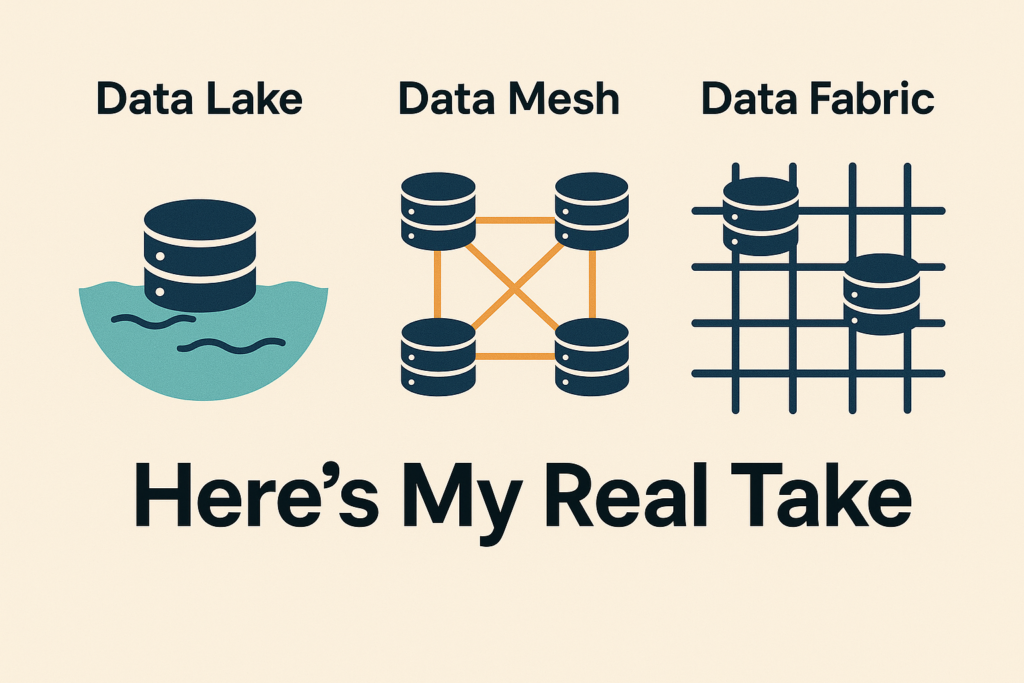
I’m Kayla. I’ve built data stuff for real teams—retail, fintech, and health. I’ve lived the late nights, the “why is this slow?” calls, and the wins that make you grin on the way home. So here’s my plain take on data lake vs data mesh vs data fabric, with real things I tried, what worked, and what bugged me.
First, what are these things?
- Data lake: One big place to store raw data. Think a huge, messy closet on Amazon S3 or Azure. You toss stuff in. You pull stuff out.
- Data mesh: Each team owns its own data as a “product.” Like mini shops on one street. Shared rules, but each shop runs day to day.
- Data fabric: A smart layer over all your data. It connects many systems. It lets you find and use data without moving it much.
For a deeper, side-by-side breakdown of how these architectures stack up (lakehouse nuances included), IBM has put together a solid analysis in IBM's comparison of Data Lakehouse, Data Fabric, and Data Mesh.
Want an even snappier cheat-sheet? I sometimes point teammates to BaseNow, whose no-nonsense glossary nails these terms in two minutes.
You know what? They all sound nice on slides. But they feel very different in real work.
By the way, if you’d like the unfiltered, behind-the-scenes version of my journey with all three paradigms, I’ve written up a hands-on review that you can find right here.
My data lake story: Retail, late nights, big wins
Stack I used: AWS S3, Glue, Athena, Databricks, and a bit of Kafka for streams. We cataloged with AWS Glue and later added Amundsen so folks could search stuff.
What I loved:
- Cheap storage. We kept click logs, orders, images, all of it.
- Fast setup. We had a working lake in two weeks.
- Our data science team lived in it. Databricks + Delta tables felt smooth.
One win I still remember:
- Black Friday, 2 a.m. Marketing wanted “Which email drove the most carts in the last 6 hours?” I ran a quick Athena query on S3 logs. Ten minutes later, they had the answer. They changed the hero banner by 3 a.m. Sales bumped by noon. Felt good.
What hurt:
- The “swamp” creep. Too many raw folders. Names got weird. People saved copies. Then more copies.
- Slow “who owns this?” moments. We had five versions of “orders_clean.” Which one was true? Depends. That’s not great.
- Governance got heavy. We added tags and rules late. Cleaning after the mess is harder than setting rules from day one.
When I’d pick a data lake again:
- You need to store a lot, fast.
- Your team is small but scrappy.
- You want a playground for ML, logs, and raw feeds.
My data mesh story: Fintech with sharp edges
Stack I used: Snowflake for storage and compute. Kafka for events. dbt for transforms. Great Expectations for tests. DataHub for catalog and lineage. Each domain had a git repo and CI rules.
How it felt:
- We had domains: Payments, Risk, Customer, and Ledger. Each team owned its pipelines and “data products.”
- We set clear SLAs. If Risk needed fresh events by 9 a.m., Payments owned that.
What I loved:
- Speed inside teams. The Risk team fixed a fraud feature in five days. They didn’t wait on a central team. That was huge.
- Clear contracts. Schemas were versioned. Breaking changes had to pass checks. You break it, you fix it.
- Better naming. When you own the thing, you care more.
What stung:
- It’s an org change, not just tech. Some teams were ready. Some were not. Coaching took time.
- Costs can creep. Many teams, many jobs, many warehouses. You need guardrails.
- Dupes happen. We had two “customer_id” styles. One salted, one not. Took a month to settle a shared rule.
One real moment:
- A partner changed a “transaction_type” enum. They told one team, not all. Our tests caught it in CI. Nothing blew up in prod. Still, it took a day of Slack pings to agree on names. Those Slack pings also reminded me how much of our collaboration (and sanity-saving venting) happens in chat rooms; if you ever need an off-the-clock space to unwind and connect with friendly folks, GayChat offers real-time conversations with an inclusive community where you can recharge before diving back into data.
On other nights when the dashboards are green early and you’re around Chicagoland looking for an even quicker offline reset, browsing One Night Affair’s Backpage Skokie listings can surface last-minute meet-ups, local events, and personal ads—turning a caffeine-fueled deploy into a spontaneous social story worth telling on Monday.
When I’d pick data mesh:
- You have several strong domain teams.
- Leaders back shared rules, not just talk.
- You want fast local control, with checks.
My data fabric story: Health care, lots of rules
Stack I used: IBM Cloud Pak for Data with governance add-ons, Denodo for virtual views, Collibra for catalog, Azure AD for access. Many sources: Epic (EHR), SAP, and a pile of vendor APIs.
How it felt:
- We didn’t copy data as much. We connected to sources and used views.
- Policy-based access worked well. A nurse saw one thing. A data scientist saw another. Same “dataset,” different masks.
What I loved:
- It helped with audits. HIPAA checks went smoother. We had lineage: who touched what, and when.
- Less data movement. Fewer nightly “copy all the things” jobs.
- One search box. Folks found what they needed faster.
What bugged me:
- Performance. Heavy joins across three systems got slow. We used caching and pushdown tricks, but not perfect.
- Setup time. Lots of config, lots of roles, lots of meetings.
- Licenses add up. Budget had to agree.
A real moment:
- A care quality report crossed Epic and a claims mart. First run was 14 minutes. We added caching on Denodo and tuned filters. It dropped to under 3 minutes. Not magic, but good enough for daily use. The compliance team smiled. That’s rare.
When I’d pick data fabric:
- You have strict data rules and many sources.
- You want one control layer.
- You can live with some tuning for speed.
So… which one should you pick?
Quick gut check from my hands-on time: Airbyte’s exploration of Data Mesh vs. Data Fabric vs. Data Lake walks through the pros and cons in even more detail.
- Go lake when you need a big, cheap store and fast build. Great for logs, ML, and ad hoc.
- Go mesh when your company has real domain teams and clear owners. You value speed in each team, and you can set shared rules.
- Go fabric when you have many systems, strict access needs, and you want a single control layer without moving every byte.
If you’re small? Start lake. If you’re midsize with strong teams? Mesh can shine. If you’re big and regulated? Fabric helps a lot.
Costs, skills, and time-to-smile
- Cost shape:
- Lake: storage cheap; people time grows if messy.
- Mesh: team time higher; surprise compute bills if you don’t watch.
- Fabric: licenses and setup are not cheap; steady after it lands.
- Skills:
- Lake: cloud basics, SQL, some data engineering.
- Mesh: same plus domain leads, CI, contracts, testing culture.
- Fabric: virtualization, catalogs, policy design, query tuning.
- Time:
- Lake: days to weeks.
- Mesh: months; it’s culture, not just code.
- Fabric: months; needs careful rollout.
Pitfalls I’d warn my past self about
- Name stuff early. It saves pain later. Even a simple guide helps.
- Track data contracts. Use tests. Break builds on breaking changes. People will thank you.
- Watch spend. Small jobs add up. Tag everything.
- Add a data catalog sooner than you think. Even basic. Even free.
- Write SLAs you can keep. Freshness, accuracy, run windows. Don’t guess—measure.
My quick grades (from my own use)
- Data lake: 8/10 for speed and cost. 6/10 for control. Call it a strong starter.
- Data mesh: 9/10 for team speed when culture fits. 6/10 if your org isn’t ready.
- Data fabric: 8/10 for governance and findability. 7/10 on raw speed without tuning.
I know, scores are fuzzy. But they match how it felt in the real trenches.
Final word
None of these is pure good or pure bad. They’re tools. I’ve mixed them too: a lake as the base, mesh for team ownership